A One-Scene Rewatch for a Quiet Evening
A one-scene rewatch helps you notice how framing, sound, and timing shape a moment, with a simple way to keep your notes specific and manageable.
The common mistake in a one-scene rewatch is trying to notice everything at once. The cost is that you retell the plot and miss how a pause, an offscreen sound, or a shift in attention changes the moment. Instead of repeating a viewing routine, follow one question that genuinely interests you and let it guide a closer look.
Choose a passage you can revisit without needing to solve the whole story: a kitchen conversation, a station platform, or a character waiting alone. Keep a notebook or phone note nearby. You do not need specialist software or technical vocabulary.
Choose a scene
A useful passage has a recognizable beginning and end, even if the film does not mark them with a title card. Pick a moment with a small change: someone enters, a conversation shifts, or a character leaves. Use a visual landmark to find it again, such as a door opening or a new location appearing.
Stick with the version you normally watch, whether it is on a streaming app, a disc, or a downloaded file. Keep captions and playback settings consistent so a setting change does not become a distraction. If the app has a bookmark feature, save the title; otherwise, use the scene’s landmarks rather than repeatedly scrubbing for a timestamp.
Start with a question
Watch the scene once at ordinary speed, without pausing or taking notes. Then write one plain sentence about what changed for you. “The room feels less welcoming by the end” is a useful starting point; save the explanation for later.
Now choose one question for a closer viewing. It might be “Who gets to look?” or “What do I hear when nobody speaks?” A precise question gives your attention somewhere to land without turning the scene into an inventory of details.
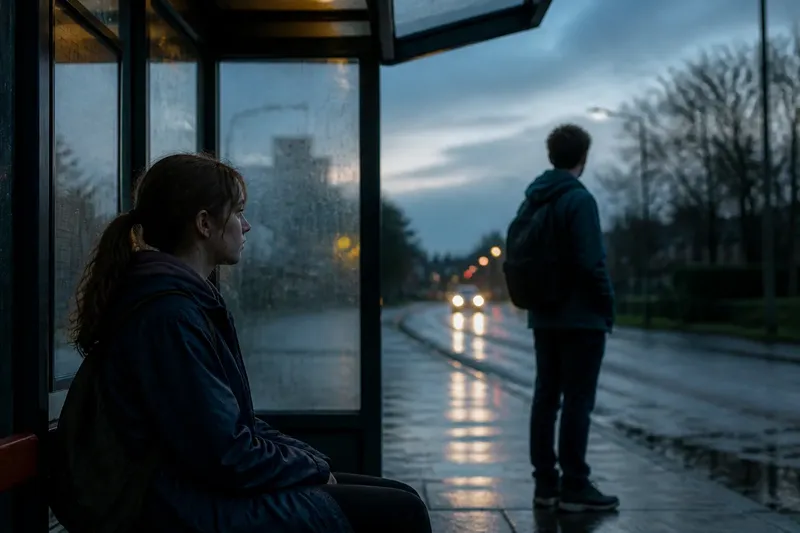
Say you choose a fictional scene of two siblings waiting at a bus stop, and your question is “Who has room to move?” You notice that one sibling stays under the shelter while the other stands beyond it. The arrangement is observable; whether it signals distance or simply blocks the wind remains open.
Read the space
Look at where people and objects sit in the frame, how much room surrounds them, and what the image leaves at the edge. A bright window may pull attention from a speaker. Someone near the edge of a wide frame may appear isolated, or the empty space may be waiting for another person to enter.
Describe the detail before deciding what it means. Instead of writing “the character is trapped,” note “the door stays visible behind her while the camera remains across the room.” That distinction keeps your interpretation attached to something the scene actually shows.
Notice what carries over
Rather than giving sound and editing separate passes, watch how one choice changes the meaning of another. A voice may continue over a cut to an empty room. A long pause may be filled by traffic, ventilation, or a faint musical cue. Ask what persists, what disappears, and whose attention the scene seems to follow.
Use ordinary descriptions when a sound or camera move is hard to name. “A low, steady rumble” is more useful than a confident guess about its source. “The shot changes after he looks away” describes timing without requiring a film-studies term.
In the invented bus-stop scene, imagine the siblings stop speaking, but traffic remains audible as the view shifts from the shelter to the open pavement. Your notes could say that the sound continues while the image changes, and that the siblings occupy separate spaces. Those details suggest a contrast, but do not dictate one fixed meaning.
When a rewatch stalls?
How small should the scene be?
Choose one exchange, entrance, or transition with a clear visual landmark at each end. If even that feels tiring, stop after one focused viewing and return another evening.
How do I stop following the plot?
Write a single question before replaying, such as “What remains audible during the silence?” If the story pulls you back in, note one concrete detail afterward instead of treating that as a failure.
What if I do not know the technique?
Describe what happens in everyday language: “the camera follows her” or “the shot changes after the door closes.” Clear observation matters more than a technical label.
What if playback is awkward?
Use a visible landmark to return to the passage and avoid repeated scrubbing. If the service makes the scene difficult to find, choose another moment with an unmistakable entrance or location change.
Keep a short record
Write down three things: the question you brought, the detail you noticed, and the interpretation you are considering. Mark the interpretation as tentative. For the fictional bus-stop scene, that could be: “Question: who has room to move? Detail: one sibling stands outside the shelter. Possibility: the framing emphasizes separation, though the weather may explain the positions.”
That small record makes a one-scene rewatch useful without turning a quiet evening into homework. The next time you try one, choose a different kind of question—about space, attention, or what continues across a cut—and let the evidence in the scene shape your answer.