When Silent Films Began Speaking in Words
When silent films began speaking in words, intertitles shaped pace, meaning, and tone. Learn how to read these cards and what they changed for audiences.
The most common mistake in watching an early silent film is treating every title card as a pause in the action. That can cost you the scene’s rhythm: intertitles shaped what audiences knew, when they knew it, and how they read a gesture. In the early 1900s, as narrative films grew longer and more complex, these cards became a practical way to identify speakers, supply dialogue, and connect scenes.
Words Between Images
Early films often relied on brief labels or explanatory text. As filmmakers built longer stories, a card could identify a speaker, clarify a change of place, or present dialogue. The familiar intertitle—text shown between stretches of moving images—offered a repeatable way to make a story legible across settings and styles.
Its appearance could be plain or ornate. A card might use a simple line on a dark field, a decorative border, or a design that echoed the film’s setting. Some cards carried dialogue; others supplied narration, a letter, a newspaper item, or a clue. Their function depended on what the image alone could communicate and on the audience’s position in the story.
That distinction matters. A line spoken by a character belongs to the scene’s exchange. A note addressed to the audience can explain something no character says aloud. A written letter shown on screen may be a prop within the story, while an intertitle presenting its contents is a device for delivering that information. The same words can feel intimate, comic, ominous, or matter-of-fact depending on how the film frames them.
Intertitles and Film History
Intertitles developed alongside the expanding ambitions of film storytelling. Exhibition practices varied: a screening might include live narration or music, and the way a film was presented could differ from venue to venue. As narrative films grew more elaborate, written cards gave filmmakers a consistent means of providing dialogue and context across screenings.
They did not arrive as a single, polished invention. Films used varied approaches to text, from short descriptive cards to expressive dialogue. Some relied on facial expression and action, using cards sparingly. Others used words to establish character, explain a plot turn, or make a joke land.
Intertitles also helped films travel. A text card could be translated or replaced for a different audience without reshooting the visual scenes. That flexibility did not erase local differences in reading habits or exhibition. A title card was never just neutral packaging: its wording and placement helped define how the images were understood.
When synchronized sound became common in commercial filmmaking, spoken dialogue increasingly moved to the soundtrack. Intertitles did not disappear from every kind of film; their role shifted. They continued as stylistic devices, as ways to show written documents, and in works that used text deliberately. This was not a simple switch from words to voices, but a change in where language appeared and how viewers encountered it.
Choose a Viewing Lens
A decision guide is useful because intertitles can do several jobs at once. Pick the question that fits your viewing situation, then follow that thread rather than trying to decode every card as a historical artifact.
- If the plot feels hard to follow, note what each card adds. If it names a place or speaker, use it to orient yourself; if it supplies information the image withholds, track how that changes the cause and effect. If neither fits, focus on the action instead of forcing a meaning onto the card.
- If a scene feels unusually funny or tense, compare the card’s timing and wording with the reaction that follows. If a blunt line sharpens a joke or a delayed explanation builds suspense, follow that rhythm; otherwise, watch how the images carry the scene.
- If you are watching a restored or translated edition, compare the card’s language and design with the surrounding images. If the edition identifies translated, redesigned, or reconstructed cards, treat those details as part of this version; if it offers no such notes, avoid assuming the cards preserve the original wording or appearance.
- If you are watching with someone unfamiliar with silent cinema, notice whether a card makes the next action easier to understand. If it offers a clear cue, connect it to the scene; if it feels dense or unclear, pause to ask what the image itself shows rather than treating the card as a complete explanation.
- If a card contains a letter or newspaper item, distinguish the document shown within the story from text added to explain it. If the card presents a character’s words, read it as part of the scene; if it addresses viewers directly, consider what information it supplies beyond the characters’ knowledge.
- If the card seems to contradict a character’s expression, compare what the character appears to believe with what the viewer has seen. If the mismatch creates irony or suspense, keep both readings in mind; if the images offer no clear clue, leave the meaning open.
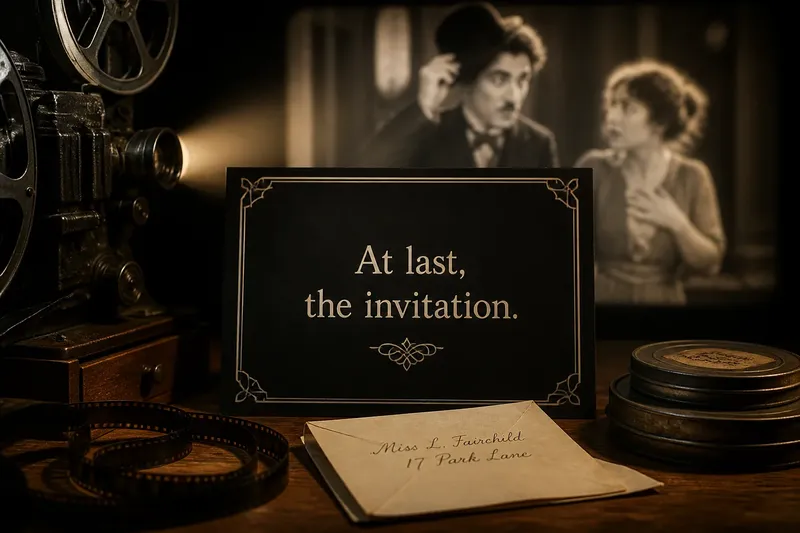
Say you are watching an invented silent comedy in which a character slips a folded note beneath a door. The next card reads, “At last, the invitation.” The character beams, but the preceding image showed the note addressed to someone else. First, you read the card as the character’s belief; then you compare it with the address and the hopeful expression. The resulting reading is comic irony: the words reveal what the character thinks, while the image lets the viewer see the mistake.
What Should You Look For?
How can I tell dialogue from narration?
Look for quotation marks, a speaker’s name, or a card inserted in the middle of an exchange, but treat these as clues rather than rules. A card that addresses viewers or explains a time jump is more likely to function as narration than spoken dialogue.
Why do some title cards look decorative?
Design can help a card fit a film’s tone, setting, or visual style, and it can distinguish a document or letter from ordinary dialogue. Decoration also affects the pause: an elaborate card invites the eye to linger, while a simple one can keep the story moving.
Are intertitles always original to the film?
Not necessarily. Prints can be incomplete, and later editions may translate, recreate, or rearrange text to make a version understandable. If exact wording matters, consult the edition’s notes or accompanying materials rather than assuming every card reproduces an original design.
What changed when films added synchronized speech?
Recorded dialogue let audiences hear characters speak while they appeared on screen, shifting much of the verbal exchange from cards to sound. Written text remained available for letters, signs, explanatory passages, and deliberate stylistic effects.
Reading the Pause
An intertitle changes the viewer’s attention. The image stops, the eye reads, and the next shot arrives with new information in hand. That pause can feel abrupt to someone accustomed to continuous dialogue, but it gives the film a distinct way to control disclosure. A card can hold back a fact, reveal it plainly, or offer a line that changes the meaning of the preceding gesture.
Pay attention to the handoff between card and scene. Does the film show the person who supposedly speaks the words? Does the next image confirm the card, complicate it, or contradict it? These questions turn text into part of the action rather than an interruption. They also help separate what the film tells you from what its characters know.
For a close viewing, choose one short exchange and notice the sequence: image, card, reaction, image. Consider whether the card arrives before or after the character’s expression changes. The ordering may make a viewer anticipate a response or recognize a misunderstanding. This is a concrete way to see how written language directs attention without assuming every card carries a hidden code.
When silent films began speaking in words, they made reading one of cinema’s viewing skills. The next time a card appears, let it do its immediate job first, then watch how the image around it reshapes its meaning. That second look often reveals the film’s quietest form of speech: not just what the words say, but when the screen chooses to let you read them.